Firewalls and endpoint agents are foundational controls, but each one can only see its own share of the network. What happens outside those areas sits in a gap neither was built to cover.
A firewall works as a checkpoint at your network’s edge. It inspects what comes in from the internet and what goes out, and it does that well. Endpoint agents work differently. They sit on individual devices and watch what happens there. Where they’re installed, they’re effective. Where they’re not, they’re blind.
Everything else sits between these two controls: traffic moving from one internal device to another, printers, cameras, IoT, BYOD, and anything else that can’t run an agent. This is where suspicious behavior can go unnoticed for weeks. It’s often where incidents develop, and where your security team has the least visibility into what actually happened. Understanding why firewalls are not enough on their own starts with understanding where their coverage ends, and what happens in the space they do not cover.
This article answers two questions that come up in almost every conversation about network security:
✅ Why are firewalls and endpoint tools not enough on their own?
✅ What kind of visibility closes the gap they leave behind?
Security foundation: firewalls and EDR
As we already discussed, a firewall stands at the edge of your network and decides what’s allowed in or out. Modern firewalls do this at high speed and with deep application and protocol inspection, keeping unwanted traffic out and sensitive data in.
Endpoint tools work on a different layer. Installed on individual devices, such as laptops, servers, or workstations, they watch what happens locally: a suspicious process, an attempt to encrypt files, or an unusual login pattern. When something goes wrong, the agent detects the activity, blocks it automatically, and notifies your security team.
Together, they cover most of the threat picture and should form the foundation of any security setup.
What NIST and MITRE ATT&CK recommend
No single tool can protect everything. A door lock keeps most people out, but you still want an alarm inside and cameras watching the premises in case one ayer fails. Each layer catches what the others miss.
Both NIST and MITRE ATT&CK are built around the same principle. NIST’s Cybersecurity Framework calls for detection across multiple layers, from the perimeter through endpoints to internal network activity. A threat missed at one point still has a chance of being caught at another. MITRE ATT&CK maps the techniques adversaries use at every stage of an attack, from initial access through lateral movement to data exfiltration, and shows how many leave no trace at the perimeter or on the endpoint.
For both frameworks, layered security is a baseline requirement. A firewall and an endpoint agent cover two important layers, and network monitoring covers what they can’t see.
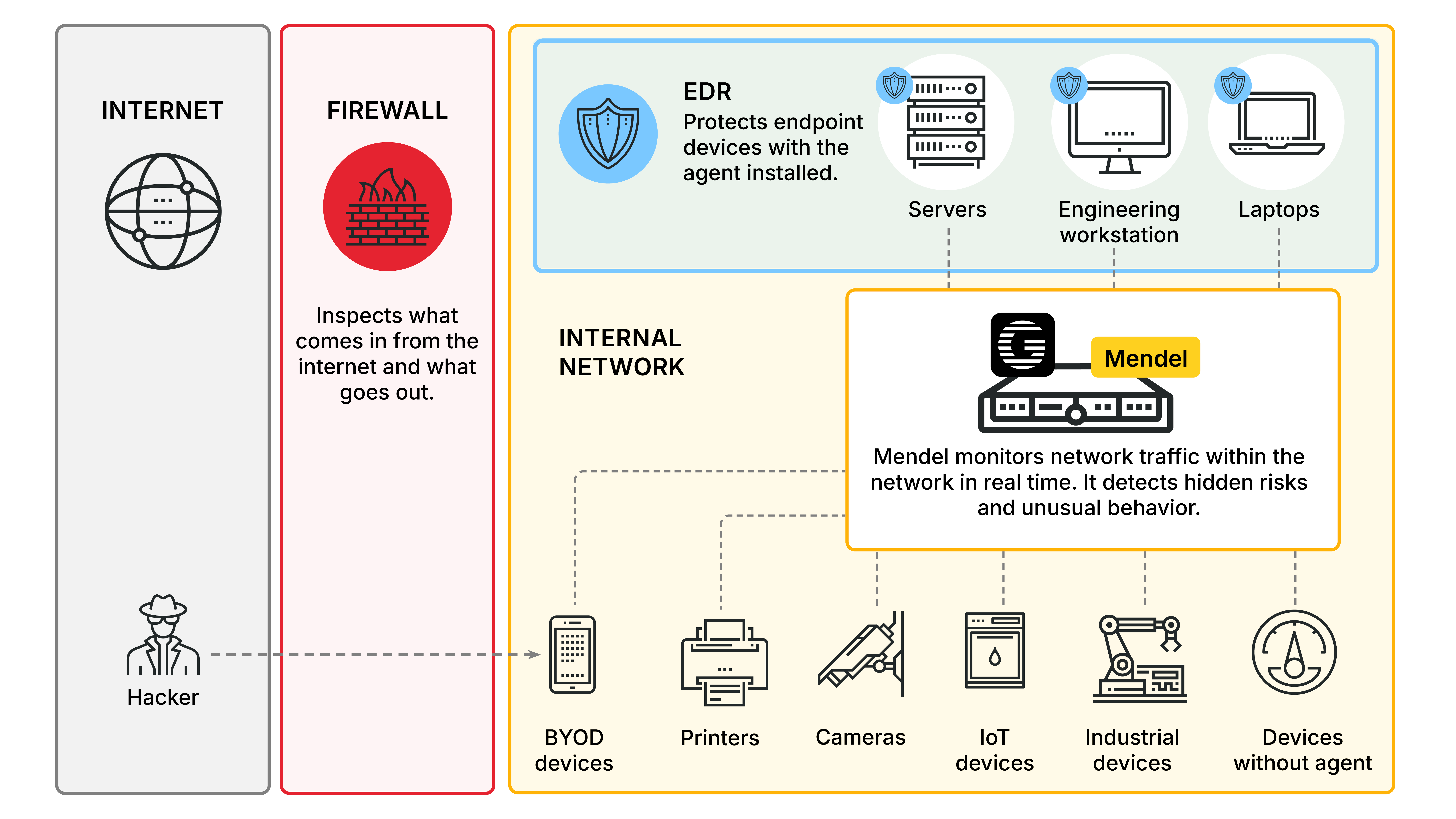
The gaps NDR closes in your network
Attackers no longer rely on obvious methods. They use legitimate credentials, encrypted channels, and AI-driven techniques to make their activity look normal to firewalls and endpoint tools. The gaps below are what NDR closes, showing why network monitoring belongs alongside your existing controls.
Gaps in visibility only NDR can close
These gaps are where most incidents actually develop, and where security teams have the least evidence to conduct a thorough investigation.
Lateral movement and east-west traffic monitoring
Once an attacker is inside, most of their activity happens between internal devices, and that traffic never crosses the firewall. Endpoint protection can be deactivated by the attacker, leaving no trace. NDR watches all internal traffic and flags any anomalous and suspicious device behavior.
Visibility into IoT, OT, and other agentless devices
Printers, cameras, medical devices, industrial sensors, and PLCs can’t run an endpoint agent, and all of them can be compromised. NDR sees these devices by watching how they communicate, without needing anything installed on them.
Detecting insider threats and credential misuse
When an attacker uses legitimate credentials, endpoint tools see nothing unusual: the login is valid, the processes are normal. NDR spots the behavior that gives it away: access to systems the account has never touched, or transfers to destinations the user doesn’t normally reach.
Reconstructing what happened after an incident
Firewalls log events but don’t store the traffic itself, and endpoint tools only cover the devices where they were running. NDR retains network metadata and can capture full traffic from suspicious events for deeper investigation. Investigators can trace exactly which devices communicated, when, and how.
Regulations like NIS2 and DORA also require organizations to provide this evidence after an incident.
NDR reveals gaps in your existing security setup
NDR gives you a clear view of your network. It surfaces unauthorized devices, weak configurations, and firewall rules that no longer match your intended policy.
Shadow IT and unauthorized network access
Networks accumulate devices no one officially approved: 4G routers, unauthorized access points, personal laptops, forgotten test servers. NDR sees every device communicating on your network and flags the ones that don’tbelong.
Weak protocols, outdated services, and configuration mistakes
Legacy protocols, expired certificates, and services running on non-standard ports pass through firewalls because the traffic is technically allowed. NDR identifies them and shows exactly which devices are still using them.
Verifying that your firewall rules actually work
Firewall configurations grow over time, and exceptions get forgotten. Temporary vendor access is never revoked, ports opened for old projects stay open, troubleshooting rules never get removed. NDR sees the actual traffic and reveals which rules are keeping doors open that should have been shut.
A complete picture of your network
Firewalls and endpoint tools are important security controls and will continue to do the job they were built for. But treating them as a complete cybersecurity strategy leaves too much of the environment unseen, and too many questions unanswered. GREYCORTEX Mendel adds the layer that closes those gaps: invisible network monitoring that sees every device, every connection, and every deviation from normal behavior. It works alongside what you already have, without adding load to endpoints or disrupting your network.
Like to discover what your current setup is missing? Run a network security audit with GREYCORTEX Mendel and see the traffic your firewalls and endpoint tools do not.
Categories
- Company News (38)
- Product News (28)
- IT/OT Security (41)
- Webinars (6)